Reading a Memoir - Night by Elie Wiesel
The impotence of language in the face of visceral horror should non be underestimated; words evade the tremulous pen. Authors revealing the sordid depths plumbed by mankind are wordsmiths of singular talent, who stare with unfaltering courage into the abyss.
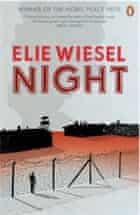
Nighttime, Eliezer "Elie" Wiesel's account of his experiences as a fifteen year former boy during the Holocaust, is a memoir of biggy ability: his humanity shines from every page equally he bears witness to the tragedy which befell the Jewish race at the hands of the Nazis. Wiesel was a Romanian-born Jew whose abode boondocks of Sighet was occupied by the Hungarians for near of the 2nd world war. In May 1944, all the Jews in the area were forced into cattle wagons and transported to Auschwitz.
The concentration camp at that place shocks with its brutality and indifference to life, and to visit Auschwitz Two-Birkenau – where each of the four crematoria attended to the daily slaughter of several thousand Jews – is to witness the void that remains when man abandons all morality. It is a scene of apocalyptic proportions: grotesque brick chimneys point their sombre fingers to the heavens, whilst all that remains of the majority of the wooden barracks are their ruined foundations. The rubble of a crematorium cowers under the weight of its own atrocities, and a breakable wind scours the air. The anguish of the past is yet snagged on the barbed wire, and a terrible misery stagnates over the army camp, its spores infiltrating the hearts of visitors in the 21st century. The desolation is overwhelming.
A person's proper name is subliminally bound up in the fabric of their existence: it tethers them to the past and anticipates their time to come remembrance. When seeking to expunge every vestige of Jewish identity from Europe, the Nazis were not content to uproot each and every Jew, rob them of their worldly possessions, shave their pilus and clothe them in rags: the ultimate affront to their identity was the replacing of every prisoner'south name with a number. This was integral to the Nazis' want to dehumanise the Jews: a number on a list carries far fewer intimate human connotations than a name. In Night, Wiesel and the other inmates were "told to roll up our left sleeves and file past the table. The three 'veteran' prisoners, needles in hands, tattooed numbers on our left arms. I became A-7713. From then on, I had no other name."
Wiesel's prose is quietly measured and economic, for florid exaggeration would non befit this subject. Yet, at times, his descriptions are so hit as to exist scenic in their pungent precision. He writes through the optics of an adolescent plunged into an unprecedented moral hinterland, and his loss of innocence is felt keenly by the reader. His identity was strained under such conditions: "The student of Talmud, the child I was, had been consumed by the flames. All that was left was a shape that resembled me. My soul had been invaded – and devoured – by a black flame."
Hunger was an immense force in the camps, eroding identities and sculpting them into dissimilar forms; information technology could hogtie a homo of principle to steal or fight, whilst thoughts of nutrient tormented prisoners' dreams. Wiesel recalled i inmate whose starvation collection him to approach ii untended cauldrons of soup on a suicidal mission, which resulted in his existence shot by a guard. The victim fell to the floor writhing, "his confront stained by the soup." Wiesel asserted that his very existence was contingent on his side by side meal: "I was zero but a body. Perhaps even less: a famished breadbasket. The tum alone was measuring time."
Yet despite all the Nazis' monstrous attempts to efface the Jewish identity, their victims's indomitable spirit could not be extinguished. Wallowing in memories was a source of incomparable solace to many, whilst others clung tenaciously to their organized religion. This was not true of all, but Wiesel befriended two brothers with whom he would "sometimes hum melodies evoking the gentle waters of the Jordan River and the majestic sanctity of Jerusalem." Thus, his identity was besieged merely not conquered: it became a taut membrane stretched across the soul.
The atrocities committed past the Nazis might have strangled hope and joy, merely the flame of life refused to perish. Even in Wiesel's darkest hours on the expiry march abroad from Auschwitz, when his mind was "numb with indifference", his survival instinct kicked in. He recognised that if he slept in the icy night, he would not wake up: "Something in me rebelled against that death. Death which was settling in all around me, silently, gently. It would seize upon a sleeping person, steal into him and devour him bit past bit." This resilience, alloyed with pure chance, meant that Wiesel non just preserved his own identity, simply lived on to preserve the identity of his race in his writing.
Night is profoundly necessary reading, non just considering it provides a spooky insight into the uniquely horrendous countenance and manifestation of the Nazis's virulent anti-Semitism, but also, as Wiesel observed: "To forget would be not only unsafe merely offensive; to forget the expressionless would be akin to killing them a second fourth dimension."
Source: https://www.theguardian.com/childrens-books-site/2014/aug/25/elie-wiesel-night-jewish-identity-amnesty-teen-takeover-2014
0 Response to "Reading a Memoir - Night by Elie Wiesel"
Post a Comment